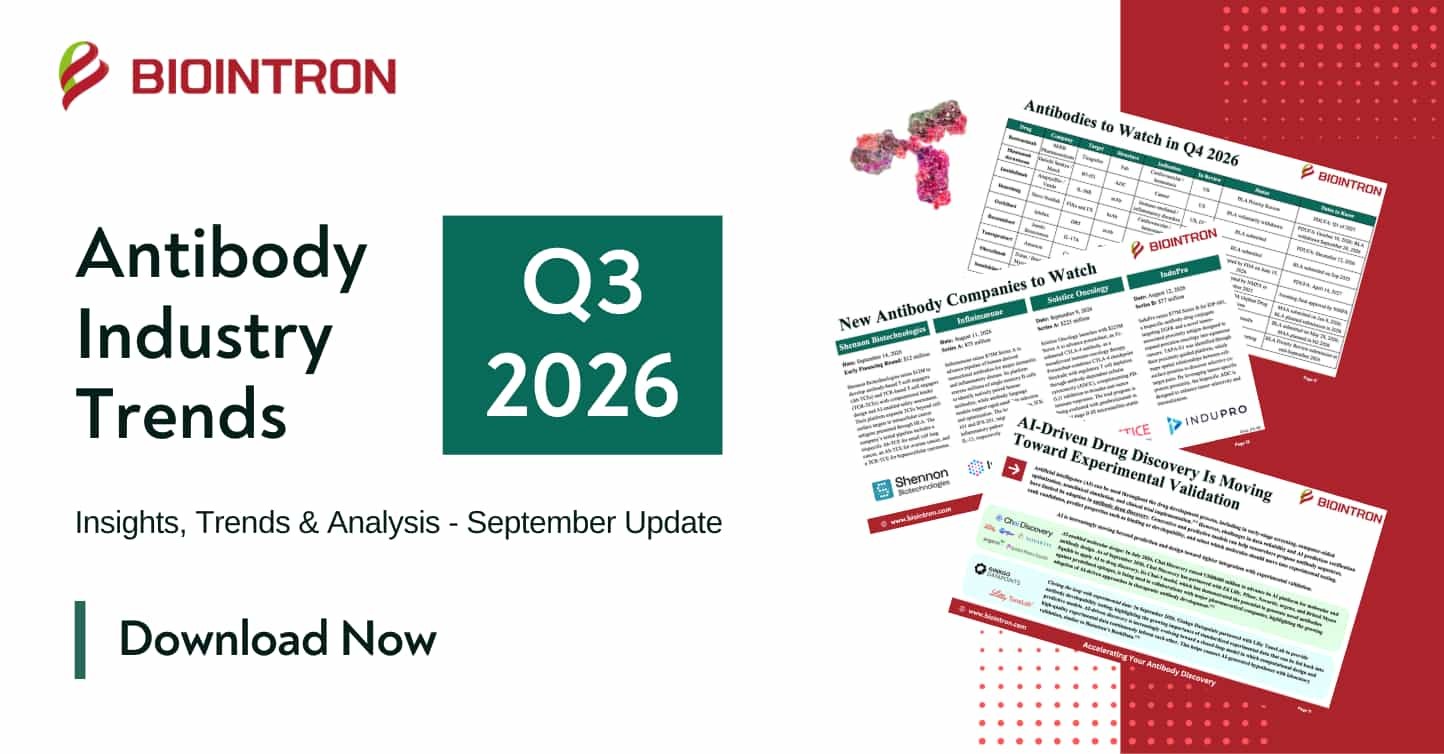
Biointron’s Q3 2026 Antibody Industry Trends report aims to explore the events and trends of the biopharmaceutical industry in July, August, and September. This quarter, ten novel antibody-based drugs have received first global approval.
Gain exclusive insights into current trends such as:
- 📣 10 novel antibody drugs approved for the first time in Q3 2026
- 💸 Top 20 antibody drug deals, including M&As, licensing agreements, and collaborations of up to US$2.9B
- 🤖 Artificial intelligence (AI)-driven drug discovery is moving toward experimental validation
- 🔬 mRNA-encoded antibodies allow the body’s cellular machinery to transiently produce and secrete antibodies
- 💊 A list of antibody drugs with soon-approaching approval action dates to keep an eye out for in Q4 2026
Register now for a free download of the report!
Selected Report Highlights
This quarter, ten novel antibody-based drugs have been approved, 7 by China, 2 by the US, and 1 in Japan.
- Recibokibart (华亦净): First approved on July 29, 2026, in China, it is a humanized IgG1 monoclonal antibody targeting IL-36R for treatment of acute flares of Generalized Pustular Psoriasis (GPP) in adults weighing 40 kg or more.
- Felzartamab (境斐): First approved on August 13, 2026, in China, it is a fully human IgG1λ monoclonal antibody targeting CD38. In combination with lenalidomide and dexamethasone, it is indicated for adults with relapsed/refractory multiple myeloma who have received at least one prior line of therapy.
- Garetosmab (Pasatru): First approved on August 19, 2026, in the United States, it is a fully human IgG4 monoclonal antibody targeting Activin A that is indicated to reduce formation of new heterotopic ossification (HO) lesions and clinician-assessed flare-ups in adults with fibrodysplasia ossificans progressiva (FOP).
- Anflekitug (Yisaina): First approved on August 20, 2026, in China, it is an IgG1 kappa humanized anti-IL-1β monoclonal antibody for treatment of acute flares of gouty arthritis in adult patients who are contraindicated for, intolerant of, or inadequately responsive to non-steroidal anti-inflammatory drugs (NSAIDs) and/or colchicine, and those unsuitable for repeated use of corticosteroids.
- Lecankitug (丽倍坦): First approved on August 28, 2026, in China, it is a recombinant humanized IgG1κ monoclonal antibody targeting IL-17A/F for treatment of adult patients with moderate-to-severe plaque psoriasis who are candidates for systemic therapy or phototherapy.
- Velinotamig (维可妥): First approved on August 31, 2026, in China, it is a BCMA/CD3 bispecific T-cell engager (TCE) for the treatment of adult patients with relapsed or refractory multiple myeloma who have received at least three prior lines of therapy.
- Clulevibart (Inmular): First approved on September 3, 2026, in China, it is a recombinant human IgG1κ monoclonal antibody targeting antigenic site II of the RSV fusion (F) protein. It is indicated for the prevention of respiratory syncytial virus (RSV)-associated lower respiratory tract infection (LRTI) in neonates and infants born at a gestational age of at least 35 weeks who are entering or were born during their first RSV season.
- Retavibart (新多妥/Xinduotuo): First approved on September 3, 2026, in China, it is a recombinant fully human monoclonal antibody targeting the Pre-F protein of RSV. It is indicated for the prevention of lower respiratory tract infection caused by RSV in neonates and infants who are entering or born during their first RSV season.
- Apitegromab (Isembyld): First approved on September 11, 2026, in the United States, it is a fully human monoclonal antibody targeting the pro- and latent forms of myostatin in the skeletal muscle. It is indicated to treat spinal muscular atrophy (SMA) in adults and pediatric patients 2 years of age and older who are currently receiving an SMN2-targeted treatment
- Gefurulimab (Klygefa): First approved on September 16, 2026, in Japan, it is a complement C5 inhibitor dual-binding nanobody for treatment of certain adult patients with generalised myasthenia gravis (gMG).
Q3 2026 saw several licensing and acquisition agreements around a variety of antibody targets for up to USD$2.9 billion, although there was less deal activity than the previous quarter.
Top 5 Deals by Volume
- Aug 31: Eli Lilly to acquire Merida Biosciences in $2.9B deal, gaining precision degradation platform for therapies that selectively target pathologic antibodies for autoimmune and allergic diseases.
- Aug 4: Pathos AI enters global licensing agreement with Alphamab Oncology on JSKN016, a TROP2/HER3 bispecific ADC in $2.2B deal.
- Jul 27: argenx to acquire Forte Biosciences in $2.2B deal, adding anti-CD122 antibody, FB102, to pipeline. FB102 has clinical proof-of-concept in vitiligo and celiac disease.
- Sep 1: Simcere Zaiming licenses trispecific antibody SIM0660 (targeting B-cell-mediated diseases) to Roche for global development in $1.53B deal.
- Sep 24: Earendil Labs announces research collaboration with Genentech to discover and develop therapeutic
bispecific antibodies in oncology in $1.5B+ deal.
AI-Driven Drug Discovery Is Moving Toward Experimental Validation
Artificial intelligence (AI) can be used throughout the drug development process, including in early-stage screening, computer-aided optimization, nonclinical simulation, and clinical trial implementation. However, challenges in data reliability and AI prediction verification have limited its adoption in antibody drug discovery. Generative and predictive models can help researchers propose antibody sequences, rank candidates, predict properties such as binding or developability, and select which molecules should move into experimental testing. AI is increasingly moving beyond prediction and design toward tighter integration with experimental validation.
Selected Antibody Companies to Watch
Date: September 14, 2026 | Early Financing Round: US$12 million
- Shennon Biotechnologies is developing antibody-based T-cell engagers (Ab-TCEs) and TCR-based T-cell engagers (TCR-TCEs) with computational binder design and AI-enabled safety assessment. Their platform expands TCEs beyond cell-surface targets to intracellular cancer antigens presented through HLA. The company’s initial pipeline includes a trispecific Ab-TCE for small cell lung cancer, an Ab-TCE for ovarian cancer, and a TCR-TCE for hepatocellular carcinoma.
Date: September 9, 2026 | Series A: US$225 million
- Solstice Oncology launches to advance porustobart, an Fc-enhanced CTLA-4 antibody, as a neoadjuvant immuno-oncology therapy. Porustobart combines CTLA-4 checkpoint blockade with regulatory T cell depletion through antibody-dependent cellular cytotoxicity (ADCC), complementing PD-(L)1 inhibition to broaden anti-tumor immune responses. The lead program is being evaluated with pembrolizumab in clinical stage II-III microsatellite-stable colon cancer.
Date: August 10, 2026 | Series B: US$100 million
- Aureka Biotechnologies is advancing biological foundation models (e.g. de novo molecular design, biological structure modeling, function prediction) for antibody drug discovery. Its AI-native platform combines large-scale biological models with AI agents, proprietary single-cell functional screening, and high-throughput experiments through a Lab-in-the-Loop system, allowing experimental data to continuously feed back into model training and molecular design.
mRNA-encoded antibodies
mRNA-encoded antibodies are an approach in which synthetic messenger RNA carries the sequence of a therapeutic antibody into cells, allowing the body’s cellular machinery to transiently produce and secrete the antibody. This differs from conventional monoclonal antibody therapy, where antibodies are manufactured as recombinant proteins outside the body and then administered to patients.
Most current approaches package the mRNA in lipid nanoparticles (LNPs), small lipid-based particles that protect RNA from degradation and help it enter cells. For full-length immunoglobulin G (IgG) antibodies, the mRNA must encode the antibody heavy and light chains so that they can be translated, assembled and secreted correctly. The same general principle can also be applied to engineered formats such as bispecific antibodies.
Antibodies to Watch in Q4 2026
Imsidolimab by AnaptysBio and Vanda Pharmaceuticals: monoclonal antibody (mAb) targeting IL-36R. Under review for generalized pustular psoriasis (GPP) indications. In GPP, innate immune responses are driven by abnormal activation of the interleukin (IL)-36-chemokine-neutrophil axis and excessive neutrophil infiltration. Expected FDA PDUFA date: December 12, 2026.
For more detailed lists and analyses, register now for a free download of the report!