Insights from the “Addressing the Challenges of Developing Advanced Modalities” panel at R&D Reimagined: Advanced Modalities, on the operational choices in capital allocation, CMC, delivery, quality, and partnerships that increasingly decide success in cell, gene, and RNA therapeutics.
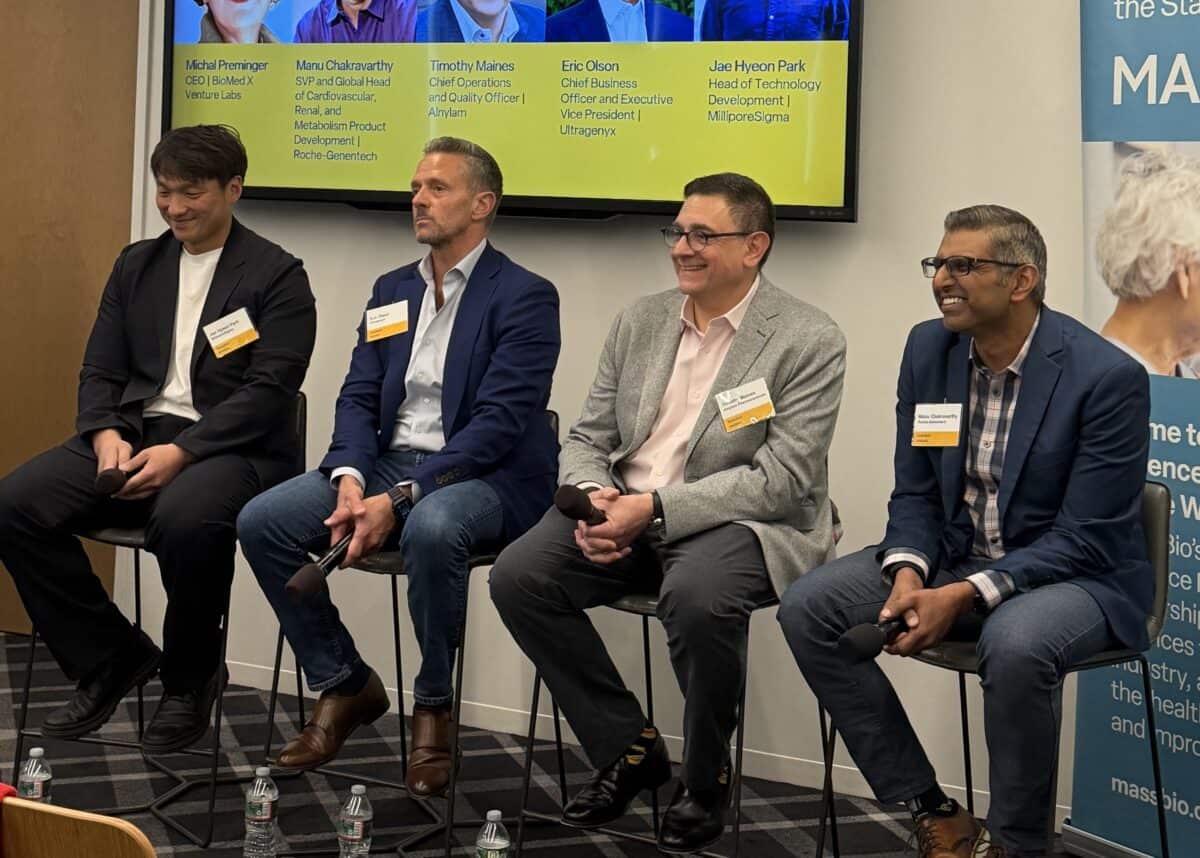
For most of the modern biotech era, the central question was whether the biology worked. In advanced modalities in 2026, that is no longer where programs are won or lost. As Michal Preminger, CEO of BioMedX Venture Labs, framed it in opening the panel, biology rarely determines on its own whether a company succeeds. Programs increasingly move forward or stall based on decisions around capital allocation, CMC, delivery, manufacturability, clinical design, quality systems, and partnerships. Those decisions are made early, often long before human proof of concept.
That is the uncomfortable insight at the center of this conversation, which brought together leaders from Roche’s Genentech, Alnylam Pharmaceuticals, Ultragenyx, and MilliporeSigma. The biology gets the headlines. The decisions below determine whether the biology ever reaches a patient.
Key takeaways for R&D leaders
- The make-or-break choices in advanced modalities are operational, not scientific, and they happen early.
- Decide your real goal first: speed to clinic or speed to market. The answer changes how much process work you do, and when.
- Manage compounding risk deliberately. Take the risks central to your value. Avoid the ones you do not need to assume.
- Define “good enough” using the actual regulatory bar, not the perceived one. Never let “good enough” touch patient safety.
- Treat reproducibility as a staged decision that scales with clinical signal and indication size, not a fixed standard applied from day one.
- Resist platform-for-platform’s-sake. Product is king. Pick the right modality for the right condition.
- Decide deliberately what to build, what to buy, and what to share. Partnerships are not a fallback. They are the operating model.
Where do advanced modality programs most often break?
The panel returned to a few failure points repeatedly. The first is treating manufacturability and CMC as something to perfect before you have proof of concept. “If you wait for the perfect process, you’re going to still be waiting,” said Tim Maines, Chief Technical Operations and Quality Officer at Alnylam. CMC is a place where teams can lose months or years optimizing a process for an asset that has not yet earned the investment.
The second failure point is isolation. No single company, person, or entity can grasp the full universe of possibilities in advanced modalities, argued Manu Chakravarthy, who leads cardiovascular, renal, and metabolism product development at Genentech. Programs break when teams do not enter the right partnerships or leverage the broader ecosystem.
Speed to clinic, or speed to market? Decide first.
Before a team spends a dollar on process development, it needs to answer one question: is the immediate goal speed to clinic or speed to market? Most advanced modality assets are pre-proof of concept, which argues for getting to the clinic first and optimizing the process later, once value has been established and the program is closer to commercialization.
Eric Olson, Chief Business Officer at Ultragenyx, made the point concrete with AAV gene therapy, one of the most complex biologics a team can produce. You can spend enormous effort tinkering toward a perfect process and never reach the clinic. Value is typically created first by establishing clinical proof of concept, then by working through the optimized process as you approach the market.
Manage compounding risk on purpose
Advanced modalities stack risk. Olson described thinking about an AAV product concept as a chain of decisions: duration of effect, the gene of interest, the vector, and the capsid. Each new technology layered in, such as a next-generation capsid, introduces new risk. The discipline is choosing which risks are central to your value and which you can avoid. Ultragenyx made the deliberate decision to use older, less novel AAVs precisely because that was a risk it did not need to assume.
The lesson for any developer: work backwards from the product concept, component by component, and decide where you are willing to take the most risk rather than absorbing all of it at once.
Define “good enough,” and never let it touch patient safety
The hardest judgment in early development is knowing what is good enough. The most useful guidance from the panel was about who makes that call. Experienced operators know the actual regulatory bar, not the perceived one. “Fear drives a lot of bad decision-making,” Maines noted. Teams over-engineer because they are guessing at where the inspection boundaries sit.
Two principles cut through the fear. You never compromise patient safety, full stop. And you do not need full GMP, full reproducibility, and every belt and suspender at every stage. Knowing the difference is what separates a program that advances from one that stalls under the weight of its own caution. For teams that lack that experience in-house, a thought partner who can co-develop the right standards can effectively raise the floor on “good enough,” as Jae Hyeon Park of MilliporeSigma’s Next Generation Drug Delivery team described from the CDMO side.
When does reproducibility become critical?
Reproducibility is not optional. Because these products go into people, it has to be part of the thinking from the start, as Chakravarthy emphasized. But reproducibility is a staged decision, not a single standard you apply on day one.
Early on, you may have one or two batches. The bar is to meet statutory requirements, introduce no safety risk, and put your best foot forward. The standard then escalates with the clinical signal. As Maines pointed out, if a candidate validates and an indication broadens from rare to specialty to prevalent, the manufacturing problem changes entirely. Clinical trials might run at gram or kilogram scale. A prevalent indication can demand metric tons. The right question is not whether you have reproducibility, but what level of reproducibility you need, and when.
Resist the platform-for-platform’s-sake trap
In the current environment, product is king. Olson, who has spent years diligencing platform companies, has watched many credential a platform to death without ever pointing to a product opportunity people can get excited about. The companies positioned to win pick the right condition for the right modality rather than forcing a single technology onto every problem. That does not mean abandoning a platform. It means threading the needle on where you put your capital and being honest about when a platform needs to become a product.
Build, buy, or share? The partnership imperative
The build-versus-buy decision runs through every advanced modality program. Both Ultragenyx and Alnylam ultimately brought manufacturing in-house, in Ultragenyx’s case after reproducibility issues with outside vendors and an opportunity to stand up a site when real estate prices were low during COVID. No one reasonably expects an early-stage company to do the same. But the panel was clear that quality and reproducibility deserve attention from day one regardless of who holds the work.
Park reframed outsourcing as shared responsibility rather than handoff. Quality is a shared culture, co-developed between a sponsor and its partners, with the end goal in view from the start. The catastrophe to avoid is discovering at the final step that reproducibility or product quality is broken and having to start over. As he put it, it is never too late to start early.
This is also how large partners evaluate small ones. More than 60 percent of Genentech’s pipeline comes from external sources. When Chakravarthy’s team looks at an early company, the biology matters, but so does the line of sight to a manufacturable commercial product, the strength of the data, and the team itself. Are they trustworthy, coachable, and good collaborators? Rarely is an early solution perfect. What partners look for is the trajectory, the incorporation of feedback, and the thoughtfulness of the team.
The throughline: it takes a village
If the panel had a single message for members building advanced modality programs, it was that no one does this alone. The world is more complex than ever, with more modalities, more diseases, more enabling technologies, and the growing role of AI in how teams design and interpret their work. No matter how well capitalized a company is, it is never enough. The companies built to win treat the ecosystem, partnerships across biotech, pharma, academia, and service providers, as the operating model, not the fallback.
For R&D leaders, the practical starting point is to make the unglamorous decisions consciously. Choose your goal. Allocate risk on purpose. Define good enough against the real bar. Stage your reproducibility. And build the partnerships before you need them.