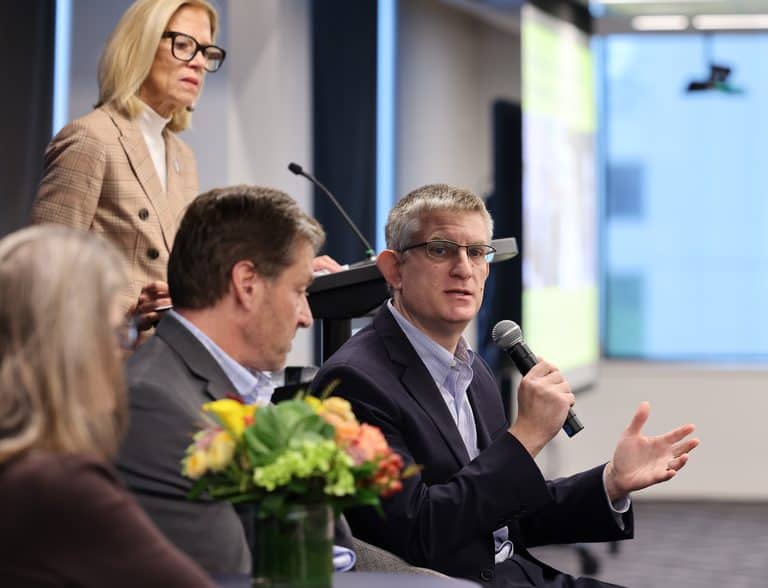
MassBio partnered with Thermo Fisher Scientific on November 20 to host R&D Reimagined, a new event designed to connect biotech and pharma R&D leadership with the industry leaders transforming the life sciences with new technologies and services.
Artificial intelligence is rapidly becoming a practical driver of innovation in drug development, but few organizations have reached the level of maturity needed to scale it effectively.
A recent analysis by PharmaSource and MasterControl found that nearly 80% of CDMOs remain in early phases of AI adoption, with most still piloting isolated use cases rather than implementing enterprise-scale systems. That gap isn’t about access to technology—it’s about readiness.
Closing that readiness gap takes time and intention. At Thermo Fisher Scientific, for example, the company’s ability to scale AI today stems from years of deliberate investment in the fundamentals, including data integrity, governance, and collaboration between digital and operational teams.
That preparation means AI can now be applied to support faster, smarter decisions across the drug development lifecycle. In this sense, Thermo Fisher’s story is less about a single deployment and more about the years of discipline that made it possible.
From experimentation to enablement
Organizations that treat AI as an overlay often struggle to move beyond experimentation. Those that embed it within existing systems and decision frameworks are finding new ways to accelerate progress and reduce complexity.
Thermo Fisher applies this philosophy across clinical research, manufacturing, and supply operations through its Accelerator™ Drug Development framework, which connects CDMO, CRO, and clinical supply solutions through shared systems, data, and expertise. The operational workflows supporting these solutions benefit from digital enablers that make scale and speed possible.
The following enterprise-level innovations are examples of how AI readiness translates into measurable progress for Thermo Fisher customers:
- DigitalSME, a digital manufacturing intelligence platform that integrates real-time production data with AI-driven analytics to surface trends, identify deviations, and support faster, more informed process decisions.
- Clinical Trial Forecasting Suite, an AI-powered planning tool that uses predictive modeling to improve accuracy in trial forecasting and resource allocation, helping reduce startup timelines by roughly 12 weeks on average.
- MySupply, an end-to-end digital supply chain platform that enables near-real-time visibility into global clinical shipments and forecasting, enhancing coordination between CDMO and CRO operations.
- AI-enabled document authoring in clinical research that automates time-consuming, repetitive tasks across the thousands of regulatory and study documents generated per phase, freeing scientific and medical writers to focus on strategic work.
Each of these tools demonstrates a simple principle: AI is most effective when it amplifies established systems of quality and governance rather than operating apart from them.
People, data, and trust
AI’s power lies not in replacing expertise but in extending it. In complex scientific environments, context and judgment remain essential. Experienced scientists, clinicians, and supply experts define what “good data” means, interpret model outputs, and apply insights responsibly. Effective governance that enables innovation while maintaining accountability is essential to ensuring the ethical use of AI and fostering trust between drug developers and service providers.
That’s why Thermo Fisher’s approach emphasizes governance before technology—clear frameworks for where and how AI can be applied, data stewardship owned by business and technical teams together, and workforce readiness to ensure every deployment is meaningful and ethical.
The company’s recent partnership with OpenAI, a leader in applied AI technology, builds on that foundation by extending digital intelligence into areas like clinical trial optimization and document automation while maintaining the same focus on responsibility and impact.
Why it matters now
As biotech and biopharma companies increasingly evaluate prospective partners on digital maturity, the ability to demonstrate integrated, AI-enabled capabilities is becoming a baseline expectation. It’s no longer enough to experiment with tools; organizations must show that technology, data, and expertise are working together to improve predictability, reliability, and efficiency. This supports accelerated development times and delivery of critical insights on health economic and patient outcomes – ultimately helping innovators bring more effective therapies to more patients, faster.
For those still in the pilot phase, the message is clear: sustainable success requires infrastructure first. AI is an accelerator, but only when it is governed, connected, and informed by people who understand both the science and the systems that support it.
The future of AI in drug development will be shaped by organizations that balance digital ambition with operational discipline, grounded in preparation, collaboration, and trust. These are the essential elements that turn innovation into real progress for patients.
About the Author

Krishna Cheriath
Vice President, Head of Digital and AI, BioPharma Services
Thermo Fisher Scientific
Krishna Cheriath serves as the Head of Digital and AI for BioPharma Services, supporting pharma services and the PPD™ clinical research businesses of Thermo Fisher Scientific, the world leader in serving science. He leverages advanced analytics and AI to enhance clinical research and patient outcomes. With leadership roles at Zoetis, Bristol Myers Squibb and prominent consulting firms like PWC and IBM, Krishna brings over 15 years of expertise in data strategy. Additionally, he is an Adjunct Faculty at Carnegie Mellon and Rutgers, contributing to the development of data-driven leadership programs.
A digital, data, and analytics evangelist, Krishna advocates for responsible and ethical innovation. His passion for positive societal change through data and digital transformation fuels his work, along with his commitment to fostering a more connected humanity. As a champion of empowered, empathetic leadership, Krishna constantly seeks new innovations and ideas to drive impactful change.