Editor’s Note
The following is a guest post from the Massachusetts Biotechnology Education Foundation (MassBioEd), a separate organization from MassBio with its own leadership, staff, and board of directors.
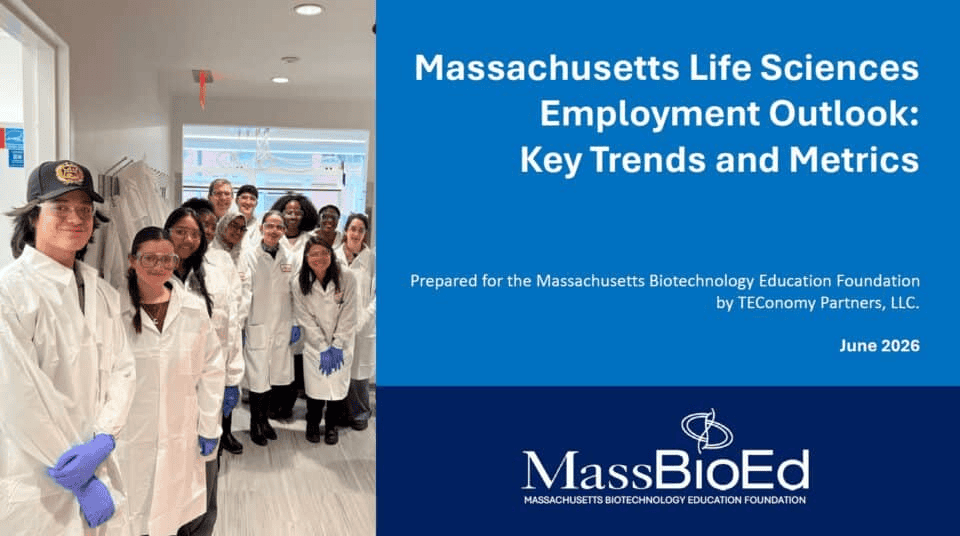
The employment figures cited here come from MassBioEd’s 2026 Massachusetts Life Sciences Employment Outlook, prepared by TEConomy Partners, LLC. That report is distinct from MassBio’s annual Industry Snapshot, and the two measure different things. MassBioEd reports life sciences employment, a broad category spanning sectors beyond drug development. MassBio’s Industry Snapshot reports biopharma employment, a narrower measure derived from a proprietary set of industry classifications and federal data. The two figures are not directly comparable, and neither report should be read as an update to or a correction of the other.
Views expressed are the author’s own.
The Massachusetts life sciences sector has transitioned into a new operational phase. Following a decade of rapid expansion in employment and laboratory infrastructure, recent data indicates that the industry has entered a period of strategic stabilization.
This trend was the central focus of the 2026 Life Sciences Workforce Conference, hosted by the Massachusetts Biotechnology Education Foundation (MassBioEd) at Boston University. Under the theme, “Building Talent Pathways in a Dynamic Time: Massachusetts Prepares the Future Workforce,” leaders from industry, higher education, and government met to analyze the 2026 Massachusetts Life Sciences Employment Outlook. The primary conclusion is that the internal technical demands of laboratories and manufacturing facilities are shifting quickly.
Key Metrics: Employment and Workforce Density
According to the report prepared by TEConomy Partners, LLC, Massachusetts life sciences employment stood at 143,224 jobs, remaining flat relative to the previous year. This plateau aligns with broader macroeconomic adjustments across the technology and science sectors.
Despite this near-term stabilization, long-term projections indicate steady demand. The state’s life sciences employment is projected to expand by 9.7% through 2030, adding 13,895 net new positions. This growth rate remains higher than the 2.8% expansion projected for the state’s overall private sector.
The regional workforce maintains a high concentration of specialized skills. High-skill occupations requiring a bachelor’s degree or higher account for 80% of life sciences roles in the state, compared to 57% nationally. While 62% of the local life sciences workforce is employed in core STEM roles, surpassing the national average of 40%.
Technical Evolution and Computing Growth
The current shifts within the industry focus on skill density rather than raw headcount growth. The integration of data analytics, automation, and advanced computation is modifying traditional operational roles in both research labs and production facilities.
While Core Scientists continue to represent the largest absolute volume of positions—with a projected 16% growth rate adding 4,063 new jobs by 2030—Computing and IT roles are growing at the fastest percentage rate. Driven by the demands of digital infrastructure and data-heavy research, Computing & IT roles are projected to grow by 31% over the same period.
The authors noted that meeting these changing demands requires targeted reskilling initiatives. The workforce increasingly needs hybrid competencies that combine foundational biological knowledge with computational skills, data management, and automated technical operations.
Aligning Academic Pipelines with Industry Demand
Conference discussions focused heavily on strengthening the pipeline between academic institutions and employers. Industry leaders discussed the gaps that sometimes exist between traditional university curricula and the technical skills required in industry roles today.
Panelists emphasized the importance of internship readiness, adaptable training models, and stackable microcredentials to help graduates transition smoothly into the workforce.
The Commonwealth maintains a strong foundation for talent production and retention; local institutions produce an average of 8,100 life sciences graduates each year. Public institutions achieve an 81% aggregate in-state retention rate for employed graduates, one-year post-graduation.
Regional Outlook
The geographic distribution of the industry also shows ongoing stability with moderate regional shifts. Middlesex County remains the primary hub, holding 64% of the state’s total biopharma and medical laboratory workforce. However, Suffolk and Worcester counties have shown steady employment gains, indicating gradual regional diversification.
The findings from the 2026 Employment Outlook confirm that while the pace of hiring has normalized, the technical expectations for employees continue to advance. Addressing these needs will require ongoing collaboration between educational institutions and industry partners to implement scalable upskilling programs.
For additional data and to download the report visit the MassBioEd Labor Market Information Hub.