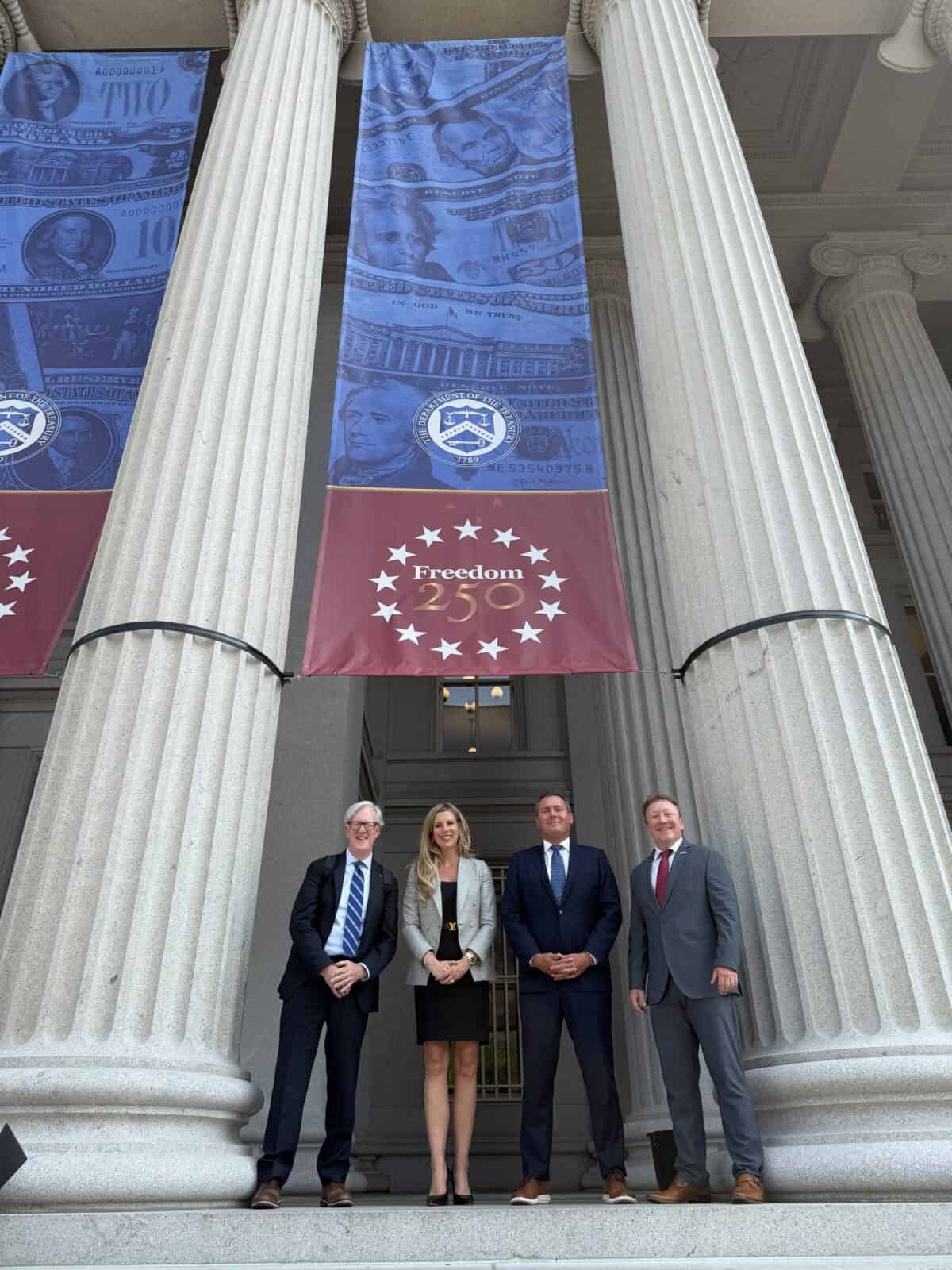
We spent this week in Washington meeting with U.S. Treasury and Congress to make a simple argument: the surest way to protect America’s biotech edge is to fix what we control at home. That case got a hearing on Capitol Hill this week, where members of both parties agreed that regulatory unpredictability is eroding our early-stage advantage even as our science stays strong. Here’s where MassBio is engaged and what’s coming next.
MassBio in DC to Defend U.S. Biotech Leadership: MassBio was in Washington this week, meeting with Treasury officials and key members of Congress to discuss how the U.S. can maintain its leadership in biotech. Our message across those meetings was consistent: proposals to restrict the flow of American capital abroad deserve careful attention to their secondary effects, and the surest path to sustained leadership runs through strengthening our own capabilities at home. Domestic reforms, chief among them a more predictable, modernized FDA, carry significant near- and long-term benefits for maintaining America’s competitive edge, and offer more durable returns than measures that simply constrain competitors.
E&C Sets the Table for PDUFA VIII: On Wednesday, July 15, the House Energy and Commerce Health Subcommittee held its hearing, Maintaining America’s Leadership in Biomedical Innovation: FDA’s Role in Advancing U.S. Drug Development. The through-line from witnesses and members of both parties was that America’s edge in early-stage development is eroding, and the driver is regulatory unpredictability rather than any decline in our science. Witnesses testified that China surpassed the U.S. in Phase 1 trial starts in 2021 and reached 35% of Phase 1 share by 2025 (versus 27% for the U.S.), and that emerging biopharma companies driving more than 75% of global Phase 1 starts are increasingly going abroad for speed and predictability. There was broad support for Operation TrialBlazer as a meaningful step, paired with a clear message that agency action alone is insufficient. Several Democratic members pressed on FDA and NIH staffing cuts, the proposed OMB grants rule, and the withdrawal of 2024 clinical trial diversity guidance. The Hearing was explicitly framed as table-setting for next year’s user fee reauthorization, and MassBio will be engaged throughout to ensure the Massachusetts perspective is at the table. MassBio submitted a Statement for the Record in advance of the hearing, detailing survey data showing 78% of members would choose the U.S. first for first-in-human trials on a level playing field but only 29% do under the current environment, and offering priorities including: modernize IND requirements, harmonize U.S. nonclinical data expectations with peer regulators, restore FDA stability and real-time engagement, and make Operation TrialBlazer durable.
House China Committee Turns to Research Security: That same morning, the House Select Committee on the CCP held a hearing, Protecting American Innovation: The Federal Research Security Enterprise, with witnesses from NSF, NIH, and DOE. As we flagged last week, the details matter enormously for a state anchored by research universities and academic medical centers, and the hearing surfaced a real tension. Members and witnesses agreed the threat from CCP research exploitation is legitimate, and that closing the gap calls for clearer, government-wide standards rather than agency-by-agency discretion. But much of the exchange focused on whether the administration’s own cuts are undermining that goal, with NSF’s research security office shrinking from 10 to 5 employees, proposed FY26 cuts of roughly 60% at NSF, 40% at NIH, and 20% at DOE, and members citing survey data on scientists considering leaving the country and a 15% drop in PhD admissions.
MassBio Comments on OMB Grants Rule: MassBio submitted comments urging OMB to withdraw its proposed Regulation for Federal Financial Assistance. The rule would layer pre-issuance political review on top of statutorily mandated peer review and restrict international collaboration and dissemination of research. Drug development runs 10 to 15 years, and research on that timeline cannot survive funding that can be revoked at will or redirected mid-course. This instability falls hardest on the small, pre-revenue companies that form the backbone of the Massachusetts ecosystem. The principle should be the same one we brought to the FDA conversation: stability, predictability, and decisions grounded in scientific merit.
Coming Up: MassBio to Comment on FDA’s Expedited IND Pilot & SEC Proposed Rule: Next week, MassBio will submit comments on FDA’s Expedited Investigational New Drug (IND) Pilot Program Request for Information. The proposed pilot would establish a network of Qualified Research Institutions to partner with sponsors on developing and reviewing first-in-human protocols, and test a rolling submission process designed to reduce Phase 1 clinical holds and shorten time to first-in-human studies, all while FDA retains full regulatory authority. This maps directly to the modernization priorities we laid out in our E&C statement, and we’ll be weighing in how to ensure the pilot accelerates U.S. FIH research. Also next week, MassBio will also submit comments on the SEC’s proposed rule, Enhancement of Emerging Growth Company Accommodations and Simplification of Filer Status for Reporting Companies. The proposal is part of Chairman Atkins’s broader “Make IPOs Great Again” agenda and works in tandem with the semiannual reporting proposal MassBio already supported. It would consolidate the current five overlapping filer statuses into two primary categories (large accelerated filers and non-accelerated filers) and extend nearly all of the scaled disclosure accommodations currently reserved for emerging growth companies to a much broader set of reporting companies. All non-accelerated filers would receive a unified package of scaled disclosures, including exemption from auditor attestation of internal control over financial reporting, and the smallest filers would get extended filing deadlines. For Massachusetts biotechs, the appeal is consistent with our position on semiannual reporting: pre-revenue and newly public companies carry compliance burdens designed for large, seasoned issuers, and right-sizing those obligations frees capital and management attention to flow back into R&D.