The breakthroughs that change the world rarely look like breakthroughs when they start — they look like unreasonable questions. Nobody in Massachusetts has built more around that principle than Noubar Afeyan, founder and CEO of Flagship Pioneering, who has spent three decades turning “What if?” into companies, platforms, and entirely new categories of science.
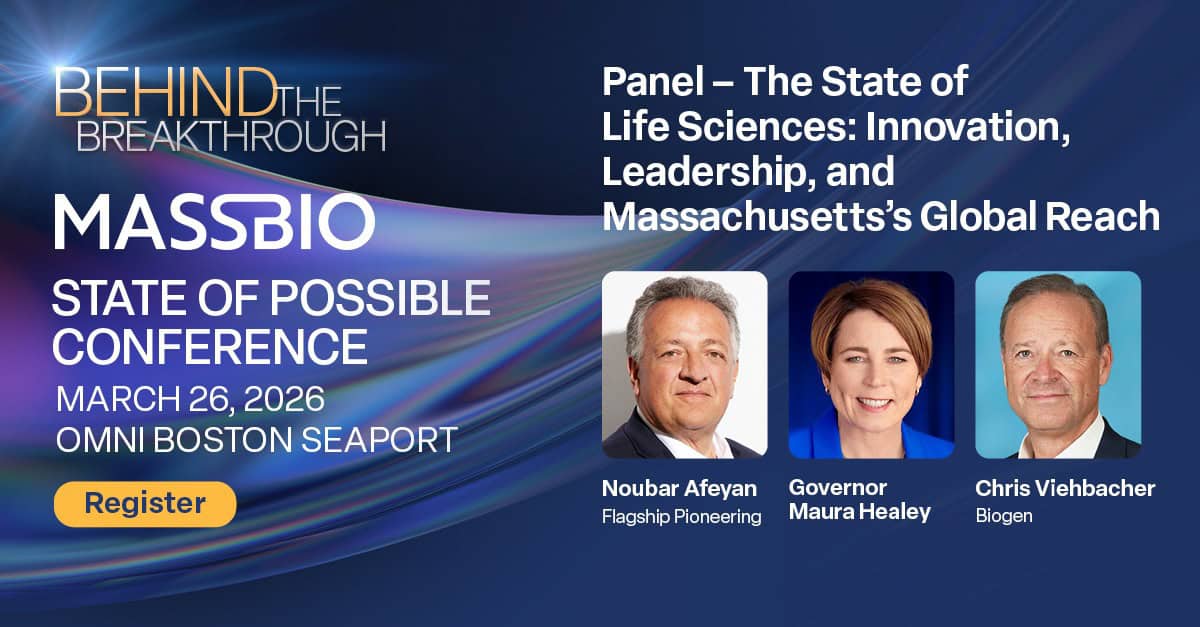
This year, MassBio will honor Noubar with the Henri A. Termeer Innovative Leadership Award at the 2026 State of Possible Conference. The recognition is well earned, and the timing couldn’t be more appropriate. Because if you follow the arc of what Noubar has been saying publicly over the past few years, you’ll find a leader whose thinking has tracked precisely with the challenges facing our industry at every turn.
Speaking previously at MassBio’s 2022 State of Possible Conference, he framed Massachusetts’s biotech rise as a sequel to the state’s 1980s tech boom along Route 128, calling it the “second Massachusetts miracle,” and challenged the industry to pursue an even bolder vision: moving beyond treating disease to preempting it. “We must imagine a future in which we secure our health instead of resigning ourselves to getting sick and only then receiving treatment,” he said. The posture was pure Flagship: ask “What if?”, imagine an outcome unconstrained by what seems possible today, and build toward it.
But Noubar wasn’t done with the word miracle. At MassBio’s Policy Leadership Breakfast the following year, he pushed further, stating that the word itself was the problem. A miracle, by definition, is something that can’t be explained. Noubar wanted to make clear that what’s happening in biotech can and should be explained. “I want to erase any residue of the myth that what we’re working on in biotech is that kind of ‘miracle’,” he told the room. “The kind of miracle we’re talking about doesn’t just happen. It emerges through the sustained and unrelenting work of scientists, entrepreneurs, investors, policymakers, and other stakeholders…and they take far longer than most people imagine.” And for Noubar, the stakes have always been personal. He spoke about losing his father-in-law during the early days of COVID and reminded the room that “for all too many, this is personal. This industry is entirely personal. The patients we treat and the lives we can save are highly personal.”
That personal urgency drove a practical argument. Quoting Churchill — “we shape our buildings, thereafter they shape us” — he made the case that smart policy is what turns a thriving ecosystem into a durable one. He called for next-generation biomanufacturing infrastructure, for workforce pipelines that bring “diverse populations, people from well beyond research-focused Cambridge” into biotech through skilled, high-paying jobs that don’t require a PhD. And he was clear about what he wasn’t there to do: “I’m not here today to say that I have or Flagship has all the right answers. Rather, I’m here to say that all of us working together have the chance to make a real difference.” His challenge to the audience was pointed: How does Massachusetts become “miracle-prone”?
Building breakthroughs is one thing, but what happens when the foundation is under attack? In a Boston Globe op-ed this past January, Noubar’s message sharpened. The scientific method itself, the engine behind every breakthrough this ecosystem has ever produced, is now under assault. AI is poised to unlock an entirely new era of discovery, but only if we defend evidence-based inquiry against those who would substitute ideology for data. “Scientists propose new hypotheses in part because they have faith in a better future,” he wrote. “In 2026, let’s choose to recommit to that faith.”
Vision. Architecture. Defense. That’s the arc of a leader who doesn’t just believe in breakthroughs but takes responsibility for the conditions that make them possible. It is exactly the kind of leadership the Termeer Award was created to recognize.
At State of Possible on March 26, Noubar will receive the award and then join Governor Maura Healey, Biogen CEO Chris Viehbacher, and MassBio CEO & President Kendalle Burlin O’Connell for a conversation on what sustains Massachusetts’s global leadership in biomedical innovation. If his track record tells us anything, he’ll be asking the next question before the rest of us have caught up.
[REGISTER FOR STATE OF POSSIBLE →]