
“My dream is that one day no kid has to suffer from a disease that can be cured. Patient advocacy means standing up even when you’re small. Love can change science, and families can change the world.”
These were the final, powerful words spoken by nine-year-old Maggie Dion at MassBio’s 2025 Patient Advocacy Summit. Her presence, her clarity, and her strides against the devastating Limb-Girdle Muscular Dystrophy Type 2C (LGMD2C) left the room silent and then energized.
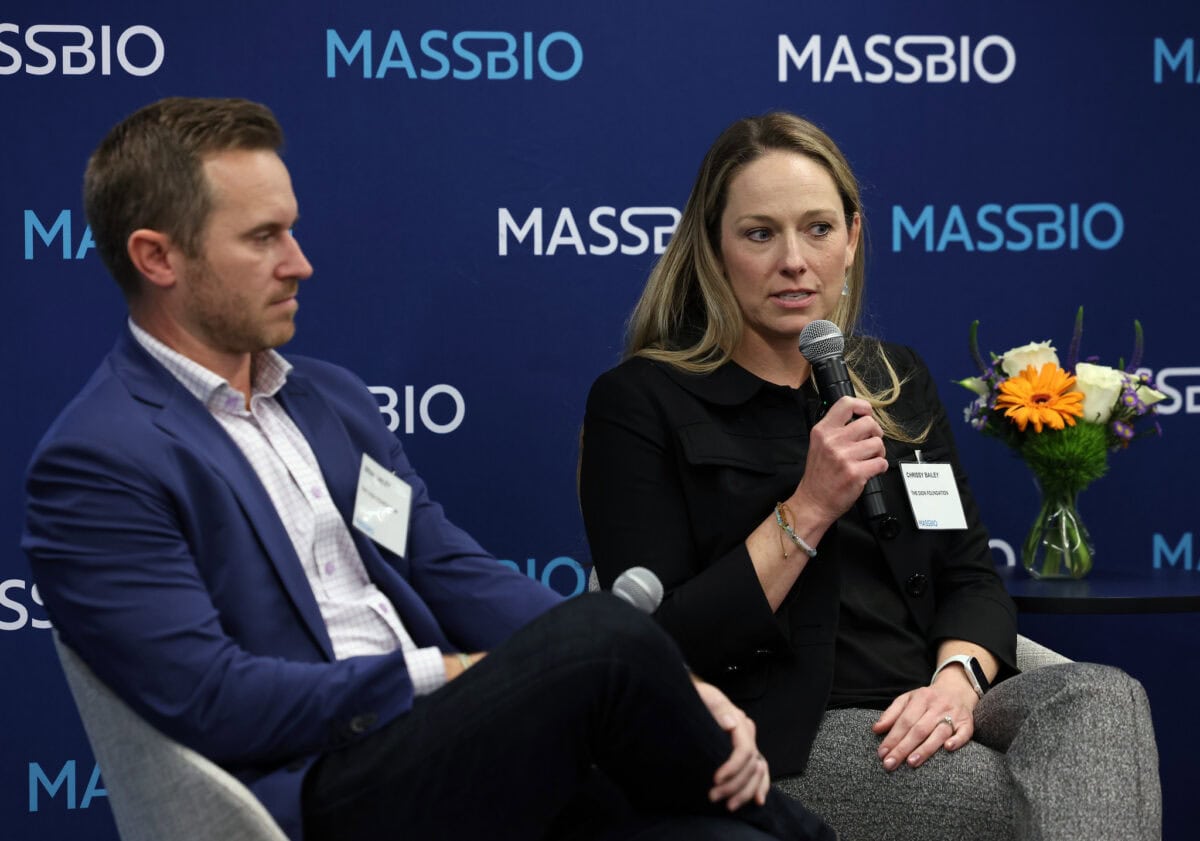
The panel, The Power of Persistence: The Dion Family’s Ongoing Journey with LGMD, brought together two remarkable families, the Dions and Baileys, along with the advocacy organization they now lead in partnership, the Dion Foundation.
Their stories reminded all in attendance that patient advocacy is the engine that moves innovation. Moderated by MassBio’s Chief Business Officer Laura Hamilton, the discussion traced two parallel journeys of heartbreak, confusion, determination – and ultimately, hope. It also revealed a new model for collaboration that has the power to reshape how rare disease communities and industry partners work together.

Two Families, One Devastating Diagnosis
For Courtney and Joe Dion, the path began in the summer of 2022 when their oldest son, Peter, struggled with routine movements like climbing ladders or pulling himself out of the pool while on a family vacation. “It hit me like a brick,” Courtney recalled. “I woke up in the middle of the night realizing it could be muscular dystrophy.” Tests confirmed the fear: LGMD2C, a severe childhood-onset subtype of Limb-Girdle Muscular Dystrophy. Soon after, their youngest daughter, Maggie, was diagnosed too.
Chrissy and Brian Bailey’s story began only months ago. Their daughters Berkley, six, and Kennedy, eight, had spent nearly a year cycling through misdiagnoses, and even dismissals, before bloodwork revealed Creatine Kinase (CK) levels 60 times above normal. “One day after gymnastics, Berkley couldn’t walk up the stairs,” Chrissy said. “That first night when we got the news… we cried all night. You feel so alone.”
But that feeling of isolation didn’t last long. Through a mutual connection, Chrissy reached out to Courtney the day after receiving their diagnosis. What began as a Zoom call quickly grew into something larger: shared understanding, shared urgency, and ultimately, shared purpose.
Turning Grief Into Action, and Building Something New
It wasn’t long after Maggie’s diagnosis before the Dions had begun building what would become the Dion Foundation, driven by an unshakable need to create answers where none existed. “We didn’t ask for a seat at the table – we are the table,” Courtney said.
Their persistence led them deep into the science of the disease, including identifying overlooked research in France. After 18 months of negotiation, they helped launch the first-ever U.S. clinical trial for LGMD2C gene therapy (ATA-200). Peter and Maggie are now among the first patients in the world to receive the treatment.
Six months later, their progress is undeniable: Maggie joined a cheer team, and Peter – once easily fatigued – is playing outside for hours. “For the first time in forever, my legs don’t even hurt anymore,” Maggie shared.
When the Baileys joined the fold, the foundation entered a new phase. Instead of starting a separate nonprofit, they chose to unite under a shared structure that allows for both a general fund and individual family funds. This innovative model lets families move together with purpose, while recognizing that no two LGMD journeys are identical.
Advocacy as a Lifeline
Both families emphasized that advocacy is essential. It fills the gaps left by a fragmented system and accelerates research far beyond what traditional pathways allow.
“You assume your doctors will send you in the right direction,” Chrissy said, “but in reality, they say, ‘See you in six months.’ To feel like your children could potentially be ignored is awful, so we will be as loud as we need to be.”
Joe echoes the call for earlier and deeper engagement from industry partners. “Advocacy should start at the beginning. Companies often want to start after FDA approval, when really it should be designed around the patient.”
Brian added what many in the room felt: “The network effect is real. Fifteen groups shouting separately won’t break through, but one or two strong voices can.”
For the Baileys, the stakes are especially high. One daughter does not currently qualify for gene therapy due to antibodies. Their advocacy remains urgent and deeply personal.
Looking Ahead: Hope, Momentum, and a Community That Refuses to Quit
When asked what excites them, Courtney didn’t hesitate: seeing the families who have struggled for years finally achieve their success stories is what keeps her going. She’s found strength in vulnerability through sharing her family’s story, a profound sense of community in the outpouring of support that ensued, and an unwavering mission in helping other families conquer rare diseases.
The Dion and Bailey families are proving exactly that. Their persistence, collaboration, and relentless hope are shaping a new blueprint for rare disease advocacy – one that unites families, researchers, and industry around a shared mission that no child is defined by a diagnosis.
Because when patients lead, progress follows. Not someday, but right now.