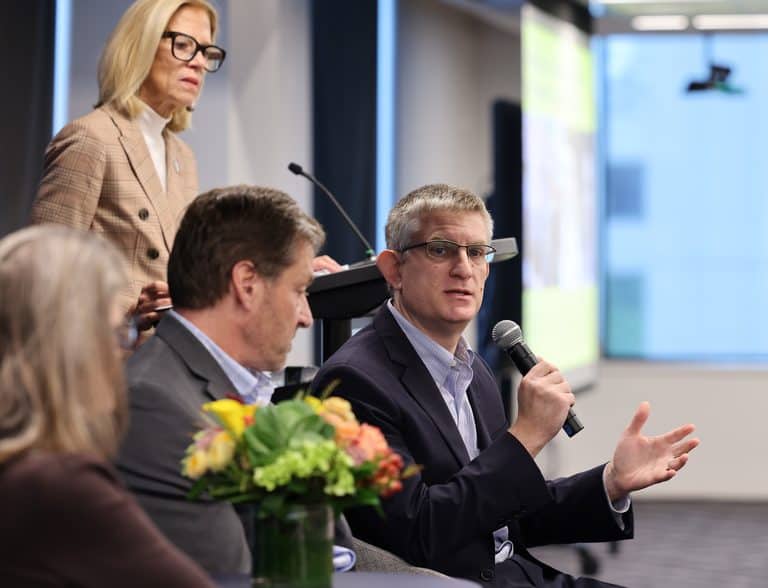
At Align Summit 2026 on October 15, MassBio put a former FDA leader, an SEC policy official, and a serial biotech founder on the main stage for “Regulators on the Record: What’s Shifting Across Capital, Approval, and Research.”
Moderated by John Stanford of Novel Strategies, the panel featured Hilary Marston, FDA’s inaugural chief medical officer and now Principal for Clinical and Regulatory Strategy at Canal Row Advisors; Jenny Riegel, Deputy Director of Policy in the SEC’s Office of the Advocate for Small Business Capital Formation; and Errik Anderson, CEO and Founder of Alloy Therapeutics.
Key takeaways
- FDA’s staffing losses are concentrated in the review areas closest to cutting-edge drug development, and the agency is aiming for stability.
- Inconsistent FDA review is partly a training problem, and some fixes, like live meeting minutes, need no new technology.
- Panelists called for a clearer conversation about how much early-stage risk is acceptable, especially in life-threatening conditions.
- Three SEC proposals could widen the pool of private investors and make it faster to raise money after an IPO.
- PDUFA VIII reauthorization and clinical trial site barriers are the 2027 issues to watch.
1. FDA’s staffing losses hit the most innovative areas hardest
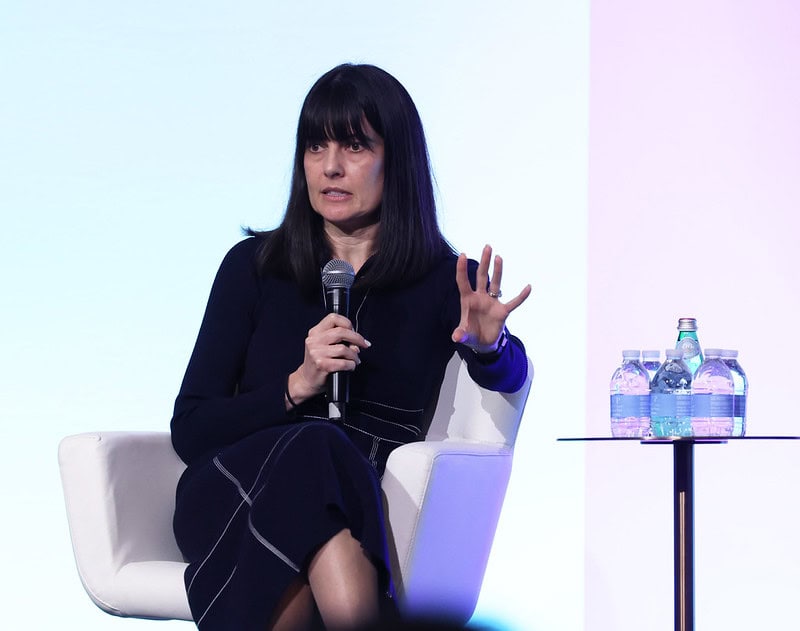
The FDA is short-staffed, Marston said, and the losses are uneven. Departures hit hardest among experts in areas like AI and real-world data, “the cutting edge of drug development,” because they had the most opportunities elsewhere. Before the cuts, an average reviewer already carried about 50 investigational new drug applications (INDs).
The agency has also absorbed a run of headlines about inconsistent reviews and overturned decisions. Her read is that career staff and political leadership now agree “it’s time to stay boring”: lean into areas of broad agreement, such as innovation in rare disease, and stay out of the news elsewhere. With a new commissioner expected, reviewers are watching the next leader’s first moves closely.
What it means for companies: Expect your experience to vary by review division, and build that into timelines.
2. Review consistency is partly a training problem, and some fixes already exist
Many complaints about FDA consistency trace back to how reviewers learn, Marston said. Review is taught by the person above you, which produces habits specific to each division.
She called much of the talk about AI reviewing applications overnight “overblown.” The nearer-term opportunity is getting divisions to learn from one another, and one example needs no technology. Companies often leave FDA meetings with minutes that don’t match the discussion. The oncology division writes minutes live on a shared screen, so everyone leaves in agreement. Other divisions should look at that model, she said.
Anderson praised the quality of FDA review as “the platinum standard.” Sponsors of every size, he said, want that quality delivered faster, with earlier feedback. To compete globally, the U.S. needs “speed, quality, and cost at scale,” and policy should “lower the cost of courage” for companies that invest and engage the FDA early.
3. The industry needs a clearer conversation about risk

Stanford asked whether some safety expectations are too conservative. Marston pointed to nonclinical toxicology, where disagreement often centers on how far below the no-observed-adverse-effect level a first-in-human starting dose must be, and whether a tenfold margin is always needed when no effect is expected. The FDA could be clearer about how it weighs that in life-threatening conditions, she said.
More broadly, Marston said the field has “probably got that dialed wrong” for some conditions, and asked whether some risk could be addressed through proper informed consent, a system she said also needs work. The topic “deserves a sober conversation,” she said.
Anderson made the stakes personal. In 2013, his father died while Anderson was trying to enroll him in a PD-1 inhibitor trial. Pembrolizumab was approved on what would have been his father’s next birthday. “There’s a true cost in human life to the delays in getting drugs approved,” he said.
MassBio’s position: In a July 2026 statement to the House Energy and Commerce Health Subcommittee, MassBio called for modernizing IND requirements, including the 1/10 NOAEL standard, and for harmonizing nonclinical expectations internationally.
4. The SEC is working to widen biotech’s access to capital
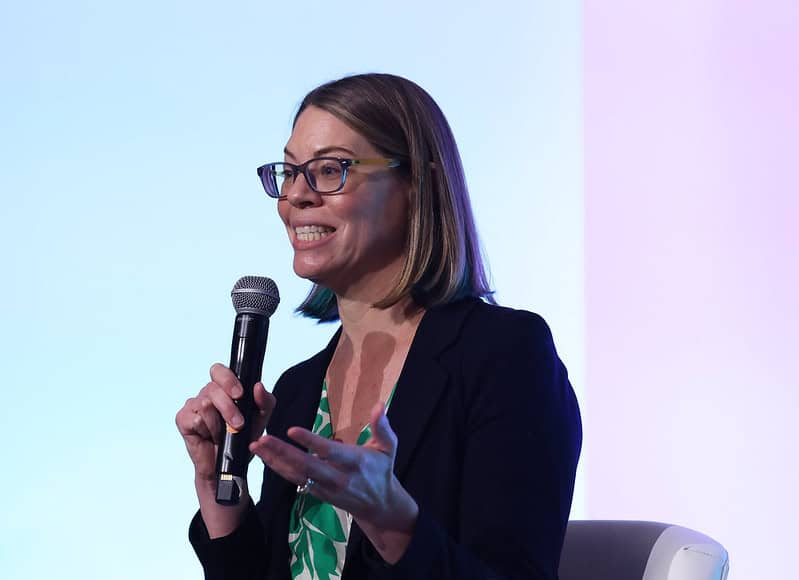
Riegel opened with what her office hears in the field: fewer seed rounds, bigger rounds, and more consolidation, which favors founders with existing investor networks. Anderson added that long timelines and hard-to-underwrite outcomes make biotech the asset class many investors least want to touch.
Speaking for herself and not the Commission, Riegel highlighted three proposals, none yet final.
- A wider accredited investor definition. On September 30, the SEC issued notices that would let people qualify as accredited investors through credentials, including a CPA license, a CFA charter, a CFP certification, certain FINRA licenses, or a new FINRA-developed exam. A larger pool of accredited investors means more potential backers for private rounds. Comments are due December 4, 2026.
- Registered offering reform. Newly public companies now wait a year to use a Form S-3 shelf, the fastest route to follow-on capital. The proposal would allow one right after an IPO, so companies could raise a right-sized IPO and return to market soon after.
- Filer status simplification. The proposal would raise the large accelerated filer threshold from $700 million to $2 billion in public float, so more companies keep lighter reporting requirements longer, and require two straight years above the threshold before a company’s status changes.
Riegel gave no timeline but said the changes are a priority for SEC Chairman Paul Atkins, and staff must review every comment first.
5. What to watch in 2027: PDUFA, trial sites, and your own voice
PDUFA VIII. “Nobody should sleep on PDUFA,” Marston said. The current authorization of the Prescription Drug User Fee Act, which funds much of FDA’s drug review, expires September 30, 2027, and as a must-pass bill it will attract riders. FDA plans to send its PDUFA VIII recommendations to Congress by January 15, 2027. MassBio’s position: In October comments to FDA, MassBio supported timely reauthorization and urged that its benefits reach sponsors of every size.
Clinical trial sites. FDA’s Expedited IND Pilot, launched in September under HHS’s Operation TrialBlazer, aims to speed the path to first-in-human trials. Marston welcomed efforts to compress IND-enabling studies but warned that U.S. phase 1 competitiveness will fail without fixing clinical trial site barriers, particularly at academic medical centers. Those barriers sit well outside FDA’s 30-day review window.
Your voice. Riegel urged companies to submit comment letters on SEC proposals, which she said are taken seriously. Her office is reachable at smallbusiness@sec.gov, and the SEC’s annual Small Business Forum, where ideas behind the 2012 JOBS Act took shape, is another place to weigh in.
2027 will be as consequential as 2026, Stanford said in closing. Companies can get involved directly with the agencies or through MassBio’s policy and advocacy work.
Frequently asked questions
On September 30, 2026, the SEC requested comment on letting people qualify as accredited investors by holding a CPA license, CFA charter, CFP certification, certain FINRA licenses, or by passing a new FINRA-developed exam. The existing income and net worth tests would remain. Comments are due December 4, 2026.
PDUFA VII expires September 30, 2027. FDA plans to send its PDUFA VIII recommendations, covering fiscal years 2028 through 2032, to Congress by January 15, 2027.
Part of HHS’s Operation TrialBlazer, the pilot pairs sponsors with qualified research institutions so FDA can review parts of an IND on a rolling basis before submission. FDA estimates it could save sponsors 6 to 12 months on the path to first-in-human trials.